Knowledge & Contributions
Suva shows up on the construction site. The safety documents are there – unfortunately, they’re in the wrong vehicle.
A contractor in the metal construction industry recently shared a situation with us that many businesses will probably recognise from everyday practice:
Safety briefings are conducted. Documents are completed and signed. The records are there.
The problem isn’t the documentation itself.
The problem is having the documents available at the right moment.
One paper folder per construction site, with additional documents kept in vehicles, in the workshop or at the office. As long as everything runs as usual, this system works.
But what happens when proof of compliance is requested without warning on a construction site?
Suddenly, the crucial folder may be in an employee’s vehicle – or at another site 30 kilometres away.
A record must not only exist. It must be accessible.
When it comes to occupational safety and compliance, properly documenting information and records is not enough. They must also be quickly accessible, complete and traceable.
Because when an inspection means making phone calls, searching for documents or driving back to the office, a record that already exists can quickly become a practical problem.
This is exactly where digital processes make a difference.
Safety briefings, training records, audits and other relevant documentation should be available wherever the work takes place.
On the construction site. In the workshop. In production.
Available digitally and accessible within seconds – regardless of where a paper folder or a particular vehicle happens to be.
Digitalisation also means finding instead of searching
Digitalising occupational safety is therefore about more than simply replacing paper with a screen.
It’s about ensuring that relevant information is available at the right time, in the right place and to the right people.
This reduces administrative workload, creates transparency and makes it easier for companies to document their safety processes in a clear and traceable way.
So, here’s a practical question:
If an unannounced inspection took place tomorrow morning, how long would it take you to present the required records?
equasio – be smart. work safe. communicate.
High staff turnover? Keep your licensing costs predictable
« What happens to licences when people are constantly changing, and what impact does this have on costs? » A question we are regularly asked at equasio – and one that is absolutely justified, especially in industries with high staff turnover.
On construction sites, in production or in other labour-intensive sectors, people joining and leaving are part of everyday business. Permanent employees move on, temporary employees join, while others leave the company again.
In a company with, for example, 300 employees and an annual turnover rate of 10–15%, this can quickly mean 30 or more staff changes per year.
If an additional software licence had to be purchased for every new person joining the company, costs would not only increase. Administration would also become unnecessarily complicated.
At equasio, the company size is licensed – not each individual person
That is why equasio’s licensing model works differently:
When a person leaves the company, their licence becomes available again and can be used by a new person joining the company.
This means:
- no need to purchase a new licence with every new hire
- no unused licences after someone leaves
- better predictable costs
- less administrative effort
- a licensing model that is based on the actual size of the company
This is particularly important for companies with regular staff turnover. Because a digital solution should simplify existing processes – not create additional administration every time someone joins or leaves.
equasio – be smart. work safe. communicate.
Hazard Identification: Recognizing Risks Before They Lead to Incidents
Why real safety starts earlier
In many companies, workplace safety only begins after something has already happened:
an accident, a near miss, or a critical incident exposes weaknesses.
But true safety starts earlier – with systematic hazard identification.
What is hazard identification?
Hazard identification is a structured process to identify and assess risks in the workplace.
The goal is to detect potential hazards early and define appropriate measures – before an accident occurs.
This includes not only obvious risks like machinery or construction sites, but also:
- work processes
- communication
- time pressure
- organizational conditions
Why is it crucial?
Consistent hazard identification offers clear benefits:
- accidents are prevented before they happen
- employees become more aware
- costs from downtime and damage decrease
- legal requirements are fulfilled
Most importantly, it strengthens the safety culture sustainably.
The core of the ASA system
Hazard identification is not just another process – it is the core of the ASA system (involving occupational physicians and safety specialists).
This system is based on EKAS Guideline 6508 and forms the foundation of occupational safety in Switzerland.
In the “10-point system,” it is central (point 5) and influences:
- safety objectives
- training and instructions
- action planning
- resource planning
- emergency organization
- audits and inspections
Without knowing the risks, effective measures cannot be implemented.
What types of hazards exist?
Hazards arise from various factors:
- work environment (construction sites, night work, lone work)
- work activities
- equipment and machinery
- substances (chemicals, gases, dust)
Typical categories:
- mechanical hazards
- electrical hazards
- hazardous substances and gases
- fire and explosion risks
- noise and vibration
- ergonomic strain
- psychosocial factors (stress, pressure)
- workplace environment and traffic routes
Legal responsibility and practice
Hazard identification is not only useful – it is mandatory.
Without it:
- employees cannot be properly instructed
- protective measures are insufficient
- legal requirements are not met
Important: this applies to everyone working within the company.
From hazard to action: the STOP principle
Once risks are identified, the key question is: what do we do?
STOP principle:
- S – Substitution
- T – Technical measures
- O – Organizational measures
- P – Personal protective measures
Reality in practice
In many cases:
- hazards are documented but not used effectively
- information gets lost
- measures are not followed up
- responsibilities are unclear
Result: limited real impact.
How Equasio simplifies hazard identification
Equasio offers a digital solution to:
- capture hazards directly on site
- assign measures clearly
- track progress transparently
- maintain accessible documentation
This transforms an administrative duty into an effective management tool.
Conclusion
Hazard identification is not a one-time task, but a continuous process.
It helps to:
- protect employees
- comply with legal requirements
- improve efficiency and quality sustainably
With the right tools, theory becomes everyday practice.

Greater clarity within the team: making communication easier and more reliable
Distributed teams have long been a reality. Whether in the office, on the construction site or on the road, good collaboration depends on clear, reliable communication. This is exactly where the Equasio app comes in with targeted improvements.
The goal is clear: fewer misunderstandings, less friction – more clarity.
Chat: understand faster, respond better
Small details make a big difference:
Typing indicator in chat: The Equasio app shows when someone is replying – this reduces duplicate messages and unnecessary queries.
More stable video playback: Media runs more reliably, even in longer chat histories.
Send multiple files at once: Attachments can be bundled and shared more quickly.
Feeds: grasp content at a glance
An overview is particularly important when there is a lot of information:
Optimised display of posts with multiple images – content appears tidier and is easier to grasp.
PDF preview: You can see which document will open right in the feed.
Improved uploads in the channel feed: More stable video uploads and the ability to select multiple images at once make sharing content much easier.
Profiles: clear separation, more control
The Equasio app also provides more structure for contact details:
New profile page with clear separation between business and private information – telephone numbers and addresses are clearly separated.
Individual privacy settings: Each person can decide for themselves which data is visible (e.g. hide private mobile number).
Conclusion
The Equasio app deliberately focuses on targeted optimisations in everyday work. Less chaos, more clarity and better collaboration – especially in distributed teams.
Why Communication Has a Major Impact on Workplace Safety
In today’s fast-paced working world, where teams are more international and diverse than ever, clear communication is key to ensuring safety and efficiency in the workplace. The importance of language in workplace safety cannot be overstated. Any misunderstanding caused by language barriers can lead not only to delays in workflows but also to accidents.
To successfully overcome these challenges, it is essential that guidelines, information, important safety instructions, and training materials are accessible and understandable to everyone. For this purpose, the Equasio app is the ideal partner for our clients. We have recognized that overcoming language barriers is a crucial step toward creating a more inclusive and safer working environment.
That is why we are pleased to announce that the Equasio app is now available in 13 languages and has been enhanced with a new simultaneous text translation feature. From German 🇩🇪, French 🇫🇷, and Italian 🇮🇹 to Spanish 🇪🇸 and Portuguese 🇵🇹, as well as English 🇬🇧, Czech 🇨🇿, Polish 🇵🇱, Albanian 🇦🇱, Turkish 🇹🇷, Croatian 🇭🇷, Slovenian 🇸🇮, and Serbian 🇷🇸, Equasio brings teams closer together and makes safety information more accessible than ever before.
With Equasio, you can significantly improve workplace safety while promoting accessibility and inclusivity. Our goal is to provide every employee, regardless of their language or background, with the same opportunities for safety and understanding.
Discover how Equasio can help you significantly improve workplace safety and ensure that every voice is heard – because safety knows no language barriers.
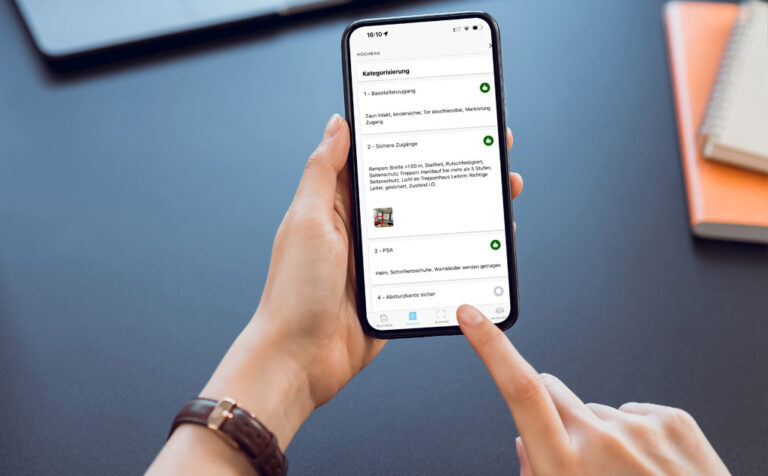
We have launched the new association app AM Suisse
With the newly developed “AM Suisse app”, fulfilling training and verification obligations becomes child’s play. The app ensures that all ID cards and training certificates of your employees and temporary employees – even when changing jobs – are always available digitally. As a result, you as an entrepreneur:in significantly reduce your administrative workload, always maintain an overview and ensure legal certainty within the employment relationships.
A central module of the app is the integrated, project-specific safety concept (SiKo) in accordance with Construction Work Ordinance Art. 4.
Functional overview of the app:
- Management of badges, qualifications and training
- Quality and process management incl. inventory of machines, equipment and personal protective equipment
- Occupational safety and health protection
- Corporate communications
- VKF prevention campaign “Fire prevention on construction sites”.
The VKF recognized the potential of the AM Suisse app and contributed to the development costs in order to have the prevention module “Fire prevention on construction sites” integrated. Every year, fires on construction sites cause property damage of around CHF 30 million. For this reason, the VKF would like to sensitize the various professional groups to the topic of fire prevention. By correctly applying the practical tips, damage, criminal consequences and civil claims for damages can be avoided.
Don’t wait any longer: stop the paperwork and avoid expired welder inspections, lost verifications or SIA118 acceptance reports. Never miss maintenance checks on equipment, personal fall protection equipment or torque wrenches again.
Learn more about the app features here.